Style Notes
What Is a Style Essence?
July 21, 2026
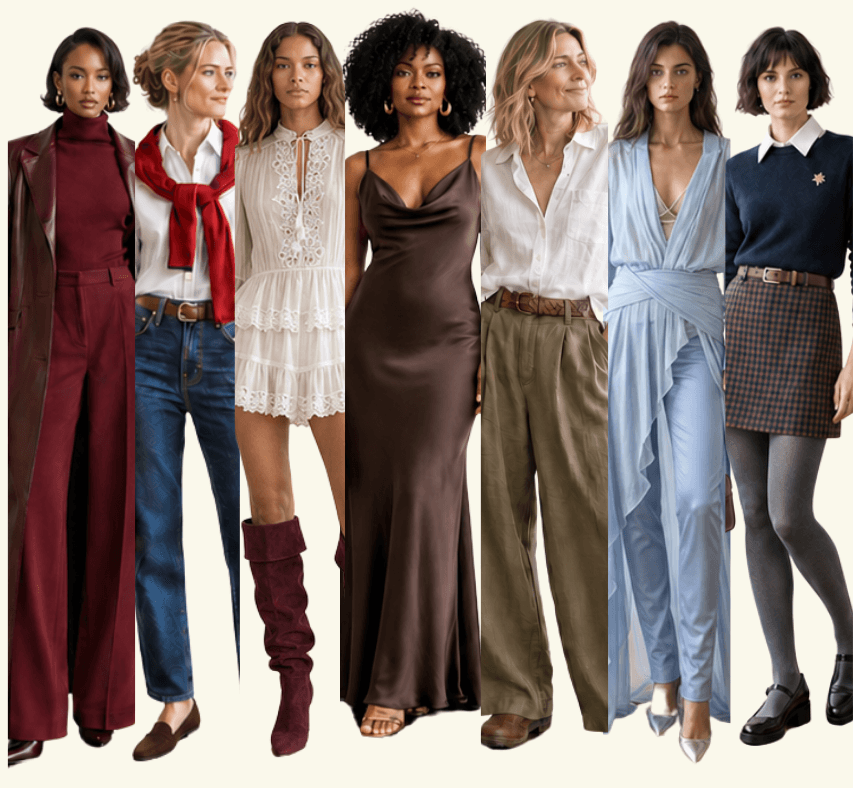
A style essence is the visual logic you return to when clothes feel right. It describes the scale, contrast, proportion, fabric behavior, and details that make you reach for one piece and leave another on the rack.
At Kirksey House, essence begins with attraction. What holds your eye? What kind of line makes you stand differently? Which detail makes a simple outfit feel complete? Which fit problem makes you reject a look immediately?
Those instincts matter. They are the beginning of personal style.
The Style Essence Quiz listens for those preferences and maps them into a primary essence and a secondary note. The result gives you language for what you already notice, even if you have never had the words for it.
It does not assign your taste from your skin tone, facial features, body shape, age, or the category someone else decided you belong in. Those systems can offer information. They do not get the final vote.
The image belongs to you.
Why I renamed the seven essences
The older structural labels could describe a line, but they could not carry the whole idea. They were accurate in the way a filing cabinet is accurate. Useful. Flat. Very little mischief.
I wanted names with history inside them. Names that could hold construction, performance, writing, image, and cultural memory. Schiaparelli says more than a shape. Vionnet says more than drape. Colette gives precision a private joke. Monroe brings the body back into the room.
The seven names are Schiaparelli, Streep, Colette, Kelly, Ophelia, Monroe, and Vionnet. Each one gives you a richer reference for how clothes can behave. None of them asks you to impersonate the woman or figure behind the name.
Your editing instinct already exists. A Style Essence gives it a name.
Your coloring is information, not permission
Color analysis says I should wear Light Spring.
I am drawn to dark green, mustard, jewel blue, and colors with weight. Some days I want to wear all black. Some days I want to wear all white. A palette may describe one kind of harmony. It cannot decide what I am allowed to want.
That distinction matters because style becomes very small when every recommendation begins and ends with what supposedly flatters your coloring or corrects your body.
You get to choose the signal.
Your essence helps you make that choice with more precision. It can tell you whether you prefer color used as a graphic field, a close tonal story, a warm body-aware note, or a luminous wash that moves with the fabric. The question is not simply, "Which color belongs to me?" The better question is, "What do I want this color to do?"
Why an aesthetic is not enough
An aesthetic gives you a finished picture. An essence gives you a way to edit.
You can save a hundred images labeled minimal, romantic, old money, maximalist, or vintage and still have no idea why one outfit feels like you while another feels borrowed. The label describes the surface. It does not explain the decision underneath it.
Essence gets closer to the decision.
Take a black dress. Schiaparelli may want a long severe column with a sculptural shoulder. Monroe may want a neckline and fabric that follow the body. Colette may choose a compact shift and let one odd brooch carry the argument. Vionnet may want the black to move through a bias cut and a hem that refuses to stand still.
Same color. Same general category. Four different instincts.
That is why aesthetics alone cannot do the whole job. They show you a room. Essence helps you decide which furniture is yours.
What a style essence actually reads
The quiz looks at five practical parts of dressing.
Scale
How much visual size feels correct? Some people need a full-length line, a decisive shoulder, or a shape that registers from across the room. Others need the smaller detail that rewards a closer look.
Contrast
Contrast can be graphic, tactile, clever, sensual, or atmospheric. Black against white is one kind. Worn leather against clean cotton is another. A strange little pin on a disciplined jacket counts too.
Proportion
Proportion is the relationship between the pieces and the body inside them. Length, volume, waist placement, neckline, and hem all change the read. When the proportion is wrong, you usually feel it before you can name it.
Fabric behavior
Fabric can hold, soften, skim, fall, float, or improve with wear. The same silhouette changes completely when the material changes. A jacket in crisp wool makes one statement. The same shape in washed linen makes another.
Detail
Detail tells the eye where to land. It may be a sculptural closure, softened cuff, contrast collar, gathered sleeve, precise neckline, antique edge, or private joke. The scale and placement of that detail matter as much as the object itself.
Together, these choices form a pattern. That pattern is your style essence.
The seven Style Essences
Here is the map in its simplest form.
- Schiaparelli: Architectural, high-contrast, and exact at full scale. The silhouette makes the argument.
- Streep: Textured, lived-in, relaxed, and already at ease. The clothes look better after they have lived a little.
- Colette: Sharp, clipped, high-contrast, and carried by one exact detail. Precision with an intelligent interruption.
- Kelly: Calibrated, balanced, proportionate, and built for the long view. Every line agrees.
- Ophelia: Fine-scale, close-detail, delicate, and strange in the best way. The signal grows stronger as the distance closes.
- Monroe: Soft, lush, body-aware, warm, and unapologetically present. The fabric follows the body instead of managing it.
- Vionnet: Fluid, luminous, draped, and in motion even standing still. Precision gives the fabric room to move.
You may recognize yourself immediately. You may feel split between two. Good. Most interesting wardrobes are not built from one note played forever.
Primary essence and secondary note
Your primary essence is the instinct that repeats most clearly. It is the line you trust first, the fit problem you notice fastest, and the quality that makes a piece feel settled.
Your secondary essence is the pressure point. It changes how the primary reads.
A Kelly primary with Colette secondary may begin with balance, then add one clipped or irreverent detail. A Streep primary with Schiaparelli secondary may keep the texture and ease, then sharpen the outer layer or strengthen the scale. A Monroe primary with Vionnet secondary may follow the body while letting the fabric move with more air and length.
The combination gives you range without turning your closet into a costume department.
Your result is a map. You remain the editor.
How to use your result
Start with what you already own.
Choose three pieces you reach for without negotiation. Ignore the occasion and price. Look at the clothes themselves.
- What scale repeats?
- Where does the contrast live?
- Which proportions make you feel settled?
- How does the fabric behave?
- What detail earns your attention?
Then choose one piece you keep trying to make work. Ask the same questions. The problem may be easier to see once you have a language for it.
A useful result should make shopping faster, outfit decisions clearer, and your own taste easier to defend. It should help you recognize what belongs before the algorithm, the rack, or another person's rules gets a vote.
Take the Style Essence Quiz.
Map your primary Style Essence and secondary note, then start naming the instincts underneath your taste.
xo, Cat